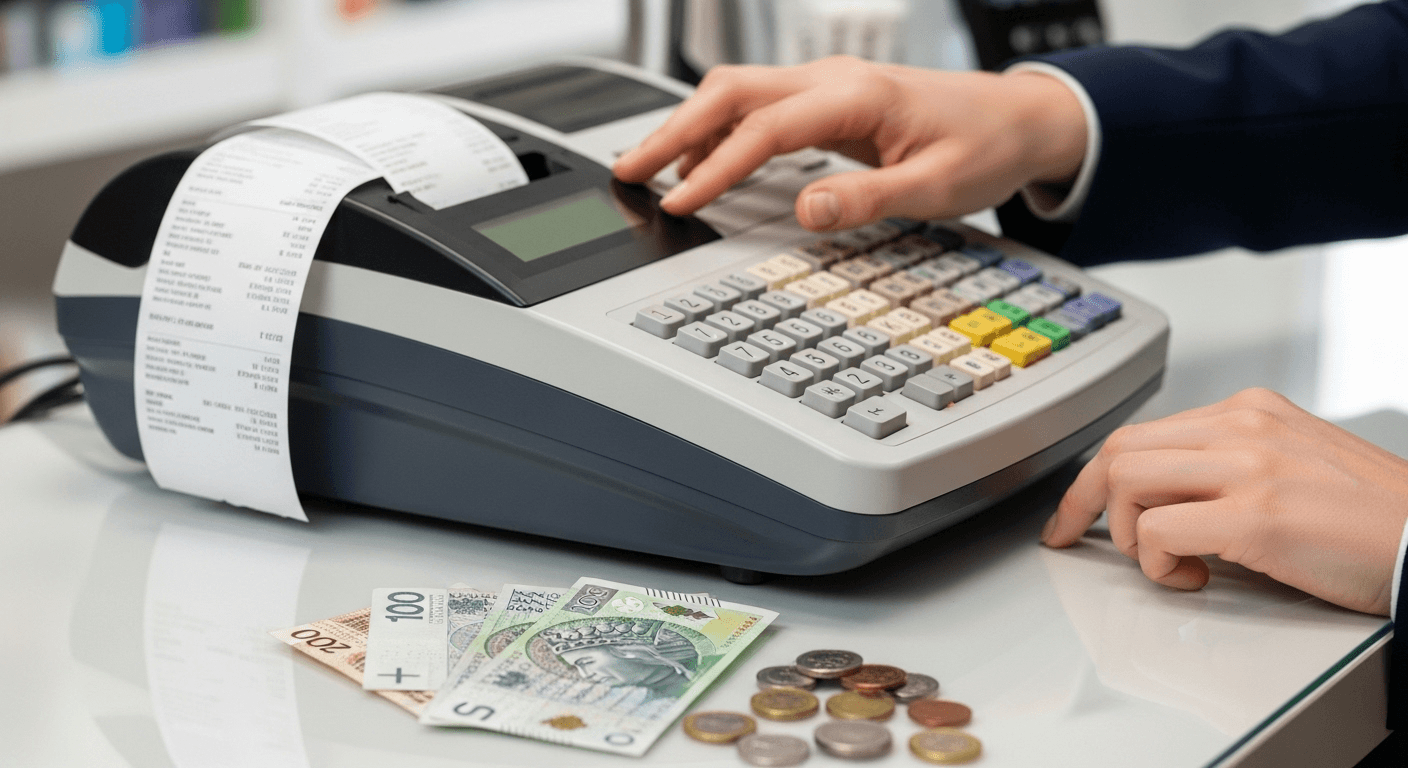
Running a business involves many tax obligations, and one of the most important is recording sales correctly on a cash register (kasa fiskalna). A particularly complicated situation arises when a customer pays into the business owner's account outside business hours. In such cases the business owner needs to know the exact deadlines and procedures for issuing fiscal receipts (paragon) to avoid problems with the tax authorities. Once the receipt is issued, the next question is how long to keep receipts.
Modern retail involves a wide range of payment methods and sales models. More and more business owners sell by mail order, accept payment by bank transfer or let customers buy online and collect the goods later. These modern forms of trade require particular care in complying with the rules on cash registers.
Legal basis for recording sales on a cash register
The obligation to record sales on a cash register is one of the fundamental obligations of VAT taxpayers in Poland. The legal rules in this area are set out in detail in the VAT Act and in the Regulation of the Minister of Finance on cash registers (since 1 July 2025 — the regulation of 25 June 2025, Journal of Laws (Dz.U.) 2025, item 845). The same regulation also covers, among other things, logging obvious errors on a cash register.
Under Article 111(1) of the VAT Act, sales to private individuals who do not run a business and to flat-rate farmers are, as a rule, recorded using cash registers. Until 31 December 2027, however, exemptions apply (Regulation of the Minister of Finance of 17 December 2024, Dz.U. 2024, item 1902): among others, for sales to such buyers of up to PLN 20,000 in the previous year (§ 3(1)(1)) and for mail-order supplies of goods and for services where the whole payment is made into a bank account and the records and proof of payment clearly show what it was for (items 41 and 42 of the annex), subject to the exclusions in § 4
The rules set out not only the obligation to keep records but also detailed deadlines for issuing fiscal receipts. The key is to distinguish between the different forms of payment and when they are made. Taxpayers must issue and hand buyers fiscal receipts when making a sale, no later than when the payment is accepted, regardless of the form of payment.
The rules on situations where payment is received before the sale are particularly important. With a cash payment, the obligation to issue a receipt arises when the payment is received. With payments made through a bank, however, the situation is more complex and several factors need to be taken into account.
The regulation on cash registers specifies that for bank payments the fiscal receipt must be issued promptly after the payment is credited to the taxpayer's account, no later than at the end of the month in which it was credited, and if the sale is made before the end of that month - no later than when the sale is made
Rules for issuing receipts for different forms of payment
Applying the rules on cash registers in practice requires understanding the differences between the various payment scenarios. Each situation has its own timing and procedural requirements, which the business owner must follow strictly.
Payment at the time of sale
The simplest situation is when the sale and the payment happen at the same time. In such cases the sale is recorded on the cash register immediately after the payment is accepted. The form of payment - whether cash, a payment card or a mobile payment - does not affect when the receipt is issued. It is different when payment comes before the sale – then the rules on receipts for advance payments apply.
In practice, this means that when a customer buys in a bricks-and-mortar shop and pays straight away, the seller must issue the fiscal receipt at the same moment. The same applies to card payments - the moment the transaction is authorised is equivalent to the moment the payment is accepted.
Cash payment before delivery
The second category covers situations where the customer pays in cash before receiving the goods or service. This may happen with special orders, reservations or purchases of goods that have to be brought in from a warehouse.
With a cash payment made before the goods are delivered, the obligation to issue a fiscal receipt arises immediately when the payment is received. It does not matter when the goods are actually delivered - the receipt must be issued when the cash is accepted
This rule is a frequent source of misunderstanding, because some business owners wrongly assume that the receipt should be issued only when the goods are handed over. The rules make it clear, however, that the decisive moment is when the payment is accepted, not the delivery.
Bank transfer before delivery
The most complicated situation is receiving payment through a bank before the sale is made. In such cases the rules provide flexible deadlines that reflect how electronic banking works in practice.
The basic rule is to issue the receipt promptly after the payment is credited to the taxpayer's bank account. However, the rules also set final deadlines, which give business owners some flexibility in applying them in practice.
Detailed procedures for payments made after business hours
A situation where a payment reaches the business owner's account after business hours requires a careful analysis of the rules and how they apply in practice. Modern banking systems allow transfers to be made around the clock, but they may be credited to the recipient's account at different times. We book fiscal reports and incoming transfers for clients whose KPiR or lump-sum tax records we keep.
The key is to distinguish between the moment the customer orders the transfer and the moment the payment is credited to the business owner's account. These two moments may be far apart in time, especially when the transfer is ordered in the evening, at the weekend or on a public holiday.
The obligation to record the sale on the cash register arises when the payment is credited to the taxpayer's bank account, not when the customer orders the transfer. This means the business owner must monitor actual incoming payments to the account, not just payment orders
Final deadlines and their significance
The rules set several final deadlines that determine the maximum time for issuing a fiscal receipt. These deadlines are of key practical importance because they reflect the realities of running a business.
The first final deadline is the end of the month in which the payment was credited to the bank account. This is the ultimate deadline: the basic rule remains that the receipt must be issued promptly after the payment is credited (§ 6(1)(2)(b) of the regulation), so a delay of a few days in checking the account does not postpone this obligation, although the receipt cannot be issued later than at the end of the month.
The second final deadline is the moment of the sale, i.e. the actual delivery of the goods or performance of the service. If the delivery takes place before the end of the month, the receipt must be issued no later than on the day of delivery.
- Check your bank account balance every morning
- Identify all new payments from customers
- Check whether the payments relate to orders awaiting fulfilment
- Issue fiscal receipts within the same working day
- Document how you check the account for inspection purposes
- Prepare a delivery schedule and match the receipt dates to it
- Keep an eye on approaching month-ends for the final deadlines
Practical aspects of monitoring payments
Managing cash register obligations effectively for payments made after hours requires suitable internal procedures. The business owner must regularly monitor the bank account and keep detailed records of all incoming payments.
Modern electronic banking systems offer various tools for notifying you of incoming payments, which can make it much easier to comply with the rules. SMS, e-mail or push notifications in mobile apps let you respond quickly to payments, even when they arrive outside business hours.
The rules do not expressly require you to check your account, but the deadlines for issuing a receipt run from the crediting of the payment, the end of the month and the delivery. That is why in practice it is worth checking the bank account balance at least at the end of each month and before each delivery of goods, to make sure that all payments have been properly recorded on the cash register
Practical examples
Understanding abstract legal rules requires analysing specific situations that may arise in business practice. Because business models and payment methods vary, each case may have its own specific requirements.
Scenario one: payment in the same month
Consider an online shop that receives an order for goods worth PLN 500. The customer makes a bank transfer on 15 April at 22:30. The bank credits the payment on 16 April at 08:00. The business owner checks the account on 16 April at 10:00 and sees the payment. The goods are shipped on 20 April.
In this case the business owner should issue the fiscal receipt on 16 April, preferably within the same working day on which the payment was found. The latest date for issuing the receipt would be 20 April - the day the goods are shipped.
Scenario two: payment at the end of the month
Another example is when the customer makes a transfer on 30 April at 21:00, the bank credits the payment on 1 May at 09:00, and the business owner checks the account on 3 May. The goods are shipped on 15 May.
In this situation the fiscal receipt should be issued on 3 May - the day the business owner finds the payment. The payment was credited to the account in May, so the final deadline is the end of May, and because the goods will be shipped earlier — the receipt must be issued no later than 15 May.
Scenario three: delay in checking the account
A more complicated situation arises when the business owner does not check the account regularly. Suppose the customer makes a transfer on 10 April, the bank credits the payment on 11 April, but the business owner checks the account only on 25 April. The goods are due to be shipped on 28 April.
If the account is checked late, the business owner cannot issue receipts with a backdated date. The "promptly" deadline runs from the crediting of the payment to the account (11 April), not from when the account is checked, so such a long delay may be challenged. The receipt must be issued immediately after the payment is found, i.e. on 25 April, and no later than on the day the goods are shipped
Consequences of non-compliance
Incorrect recording of sales on a cash register may have serious financial and legal consequences for a business owner. The tax inspection authorities regularly carry out inspections of compliance with cash register obligations.
The basic sanctions are fines under the Fiscal Penal Code (Kodeks karny skarbowy, KKS) and — where the taxpayer fails to start recording on a cash register — an additional tax liability under the VAT Act. The amount of the fine depends on the type and gravity of the breach and on the offender's financial situation (Article 48 § 4 KKS); a penalty notice (mandat) may impose a fine of up to five times the minimum wage (Article 48 § 2 KKS; PLN 24,030 in 2026, PLN 24,750 from 1 January 2027).
| Type of breach | Penalty | Legal basis | Further consequences |
|---|---|---|---|
| Selling without using the cash register, failing to issue a receipt | Fine of up to 180 daily rates; in a case of lesser gravity, a fine for a fiscal petty offence | Article 62 § 4 and 5 KKS | Correction of the VAT settlement |
| Cash register records kept in breach of the rules (defective), e.g. a receipt issued late | Fine for a fiscal petty offence | Article 61 § 3 in conjunction with Article 53 § 21(5) KKS | Tax inspection |
| Records that do not reflect the actual state (unreliable) | Fine of up to 240 daily rates; in a case of lesser gravity, a fine for a fiscal petty offence | Article 61 § 1 and 2 KKS | Tax arrears with interest |
| Failure to start recording on a cash register despite the obligation | Additional liability: 30% of the input VAT on purchases of goods and services | Article 111(2) of the VAT Act | Not assessed on an individual liable for the same act under the KKS |
Apart from fines, the business owner may expect more frequent inspections, and incorrect recording may lead to tax arrears together with default interest.
Cash register records are a "book" (księga) within the meaning of the Fiscal Penal Code (Article 53 § 21(5) KKS). Unreliable or defective records on a cash register are therefore subject to the same sanctions as unreliable or defective keeping of other tax books
Modern technological solutions
Technological progress makes it much easier to comply with cash register obligations. Modern cash register systems offer advanced functions that automate many processes and minimise the risk of errors.
Integrating cash registers with electronic banking systems makes it possible to detect payments automatically and generate reminders to issue receipts. Such solutions are particularly useful for business owners with a high volume of online sales.
- Automatic notifications of payments into the bank account
- Integration with order management systems
- Ability to issue fiscal receipts remotely
- Cloud backup of data for secure records
- Automatic reporting for inspection purposes
- Synchronisation with the delivery and shipping calendar
Customer relationship management systems can be integrated with cash registers, which makes it possible to track the status of orders and payments automatically. When the system detects a payment from a customer, it can automatically generate a reminder to issue a fiscal receipt.
Modern online cash registers make it possible to issue receipts from anywhere, which is particularly useful when a payment arrives after business hours. The business owner can issue a receipt even from home, using a secure internet connection
Planning and organising processes
Managing cash register obligations effectively requires a systematic approach and well-organised internal processes. Business owners should develop clear procedures for different payment situations.
A key element is to set up a schedule for checking bank accounts. Regular monitoring of payments, ideally every morning, makes it possible to react quickly and meet all deadlines. In larger businesses it is worth appointing a specific person responsible for this process.
A trading business that receives many bank transfers from individual customers every day can easily miss the deadlines required by law without a well-organised process for checking payments and issuing receipts. A daily schedule for checking the account, for example at 9:00 in the morning, reduces this risk.
Documenting processes is equally important. The business owner should keep a log of all account checks, with dates and results. Such documentation may be useful in the event of a tax inspection.
It is also worth preparing procedures for exceptional situations, such as banking system failures, technical problems with the cash register or the absence of the person responsible for recording sales. Backup plans can prevent breaches of the rules in difficult situations.