Every entrepreneur running a business in Poland must meet a number of obligations relating to keeping company records. The law imposes detailed requirements on how, where and for how long different types of documents are archived. Failing to comply may have serious financial and legal consequences.
Modern technology allows entrepreneurs to keep and archive records electronically, which makes managing company information much easier. However, moving to digital solutions requires knowledge of the relevant rules and appropriate technical safeguards.
Basic obligations for keeping records
Every entrepreneur, regardless of the legal form of the business, must keep company records in their original form for the statutory period. These documents should be kept at the company's registered office, place of business or branch, and where bookkeeping is outsourced to an accounting office – at the place specified in the contract with the office (Article 60 § 2 of the Fiscal Penal Code). Entities keeping full accounting books may also hand over their records for safekeeping to a company providing document storage services (Article 73 section 4 of the Accounting Act). The address where accounting records are kept is given in the identification notification – an entrepreneur registered in CEIDG (Central Register and Information on Economic Activity) in the CEIDG application, and a company registered in the KRS (National Court Register) in the NIP-8 form (Article 5 sections 2b, 4 and 5a of the Act on the Registration and Identification of Taxpayers and Payers).
An entrepreneur must keep company records in their original form for the period set out in the law. Documents must be available at the indicated storage location throughout the required retention period
It is particularly important to keep in the proper form the adopted accounting policies, accounting and tax books, accounting and stocktaking documents, as well as financial statements. These categories of documents underpin the company's accounting system and are subject to the strictest archiving requirements. In entities applying the Accounting Act, approved financial statements are kept for at least 5 years from the beginning of the year following the year of approval, and accounting books, accounting vouchers and stocktaking documents for at least 5 years from the beginning of the year following the financial year to which they relate (Article 74 sections 1–3). Practical tips on organising your archive can be found in our guide on how to store accounting documents properly.
The entrepreneur is also responsible for protecting documents against various threats. This includes protection against damage or destruction, which may result from external or internal factors. It is equally important to prevent unauthorised changes to documents that could affect their reliability and evidential value.
Company documents must be protected against damage, destruction, unauthorised changes and unauthorised disclosure (Article 71 section 1 of the Accounting Act). The entrepreneur is responsible for ensuring the integrity and security of all records for the required period
Unauthorised disclosure of documents is another threat you need to guard against. This applies in particular to documents containing employees' personal data, customer information or the company's financial data. Proper access control systems and security procedures are essential to meet this requirement.
Keeping company records electronically
Polish law allows entrepreneurs to keep company records electronically, which makes managing company information much easier. Electronic archiving offers many benefits but requires certain technical and organisational conditions to be met.
Making backups systematically is the foundation of secure electronic storage. Regular backups protect against data loss in the event of hardware failure, human error or other unforeseen events. Backups should be kept in different locations to reduce the risk of losing all data at once.
Electronic storage of records requires systematic backups and protecting the computer against viruses. The entrepreneur must be able to reproduce documents as printouts at any time (Article 73 section 2 of the Accounting Act)
Protection against viruses and other malware is equally important for the security of electronic records. Today's cyber threats can lead to damage, destruction or theft of data, so up-to-date antivirus software and regular security updates are essential.
Having a device that can reproduce the data as printouts is a key requirement for electronic storage. Inspection authorities must be able to read the documents in a legible form, which requires a working printing system and printouts of adequate quality.
An entrepreneur may archive the following categories of documents electronically (in accounting books excluding, among others, documents transferring rights to real estate, entrusting responsibility for assets and significant contracts – Article 73 section 2 of the Accounting Act):
- Accounting or tax books recording business transactions
- Accounting vouchers confirming transactions and financial operations
- Copies of cash documents relating to cash transactions
- Stocktaking documents prepared during physical counts
- Financial statements presenting the assets and financial position
- Payrolls containing information on employees' pay
Electronic archiving also covers all copies of documents originally created in digital form. This applies to bank statements, posting orders and tax returns filed electronically
A special category consists of documents originally created in electronic form, such as bank statements received through online banking, posting orders generated by IT systems and tax returns filed through online platforms. These documents can be archived in their original digital form without having to be printed.
Tax records - requirements and retention periods
Tax records are a special category of company documents, subject to specific rules on retention periods and archiving methods. This category includes invoices and bills documenting business transactions, records relating to tax collection and withholding, and the tax books kept by entrepreneurs.
Tax records are kept until the tax liability becomes time-barred, i.e. as a rule for 5 years from the end of the calendar year in which the tax payment deadline passed (Article 86 § 1 and Article 70 § 1 of the Tax Ordinance Act (Ordynacja podatkowa), Article 112 of the VAT Act). This period is crucial for planning archive space and organising the company's document storage system.
Tax records must be kept until the tax liability becomes time-barred, as a rule 5 years from the end of the year in which the tax payment deadline passed. Failing to do so may result in a fine under the Fiscal Penal Code, e.g. up to 180 daily rates for failing to keep invoices or proof of purchase (Article 62 § 3)
The consequences of failing to keep tax records can be very severe for an entrepreneur. For a fiscal offence the court imposes a fine in daily rates, and in less serious cases the fine for a fiscal petty offence may be up to 20 times the minimum wage – in 2026 up to PLN 96,120, and from 1 January 2027 up to PLN 99,000 (Article 48 § 1 of the Fiscal Penal Code).
Archiving tax records requires a systematic approach and proper organisation. Documents should be arranged chronologically and by subject, which makes them easier to find during tax inspections. Particular attention should be paid to VAT invoices, which are subject to detailed formal and substantive requirements.
Electronic storage of tax records is allowed, but it requires additional security conditions. IT systems used for archiving must ensure data integrity, the ability to reproduce data and protection against unauthorised access. Structured invoices issued in KSeF (National e-Invoicing System) are stored in that system for 10 years from the end of the year of issue, and during that time the taxpayer does not have to store them separately (Article 112aa of the VAT Act).
ZUS records - specific requirements
Running a business involves registering as a contribution payer with ZUS (Social Insurance Institution). This registration generates a number of documents whose storage is subject to specific rules that differ from the general principles for archiving company records.
The rules do not set a specific retention period for documents confirming registration with ZUS or documents confirming the right to settle contributions for employees. Because these documents must be shown during inspections, it is accepted in practice that they should be kept for as long as the business operates.
Documents confirming registration with ZUS and the right to settle contributions should be kept for as long as the business operates. During an inspection, the entrepreneur must be able to show these documents to the inspection authorities
Retention periods for documents relating to ongoing ZUS contribution settlements are set out much more precisely. Copies of settlement declarations, personal monthly reports and their corrections must be kept for 5 years from the date they were submitted to ZUS (Article 47 section 3c of the Social Insurance System Act), and in practice the other settlement documents as well:
- Settlement declarations filed monthly or quarterly
- Personal monthly reports containing data on insured persons
- Corrections to previously filed declarations and reports
- Documents confirming the contribution base
- Summaries of contributions for individual settlement periods
The five-year retention requirement applies both to documents submitted on paper and to those submitted electronically through ZUS online platforms. Copies of all documents submitted must be kept together with confirmations of delivery. As a rule, contributions become time-barred 5 years from the date they fall due (Article 24 section 4 of that Act).
Copies of settlement declarations, personal monthly reports and corrections must be kept for 5 years from the date they were submitted to ZUS. This applies to documents in both paper and electronic form
A special category consists of payroll documents used to determine the basis for calculating a pension or disability pension – payrolls and pay records. The payer keeps them for 10 years from the end of the year in which an employee or contractor registered after 31 December 2018 stopped working for it, and in other cases for 50 years from the end of work, unless it has submitted a ZUS RIA information report for the insured person – then 10 years from the end of the year in which it was submitted (Article 125a sections 4–4b of the Act on Pensions from the Social Insurance Fund (FUS)). In practice this means a very long archiving period, often longer than the standard retention periods for other company documents.
Employee records - new rules since 2019
The rules for keeping employee records changed significantly under the Act of 10 January 2018 amending certain acts in connection with shortening the retention period for employee files and their digitalisation (Journal of Laws (Dz.U.) 2018 item 357), in force since 1 January 2019. These changes had a major impact on employers' obligations and the way HR records are managed. The details are now set out in the regulation on employee records (consolidated text Dz.U. 2026 item 474).
Before 2019, the rules required employers to keep employee records, as a rule, for 50 years from the end of work for a given employer. This long archiving period was a significant organisational and financial burden for businesses.
Until 2019, employee records had to be kept for 50 years from the end of employment. The new rules shortened this period considerably and at the same time introduced the option of keeping files electronically
The 2018 Act introduced a number of fundamental changes in the approach to employee records. The first major change was replacing the long phrase "documentation relating to the employment relationship and employees' personal files" with the shorter and more precise term "employee records" (dokumentacja pracownicza).
Another important change was the introduction of penalties for failing to keep records for the required period. Failing to keep employee records for the required period or leaving them in conditions that risk damage or destruction is punishable by a fine – from 8 July 2026 from PLN 2,000 to PLN 60,000 (Article 281 § 1 points 6a and 7 of the Labour Code (Kodeks pracy)).
The amendment also made electronic and paper records equivalent, giving both forms the same legal force. This groundbreaking solution opened the way to digitalising HR processes and made managing employee records much easier.
The new rules gave electronic records the same legal force as paper records. Employers can choose between paper and electronic form according to their needs
The most important change was shortening the retention period for employee files from 50 to 10 years. This significantly reduced businesses' organisational burden and archiving costs.
Retention periods for employee files after the 2019 changes are as follows:
| Employee category | Retention period | Additional requirements |
|---|---|---|
| Hired from 1.01.2019 | 10 years from the end of the year employment ended | Monthly report to ZUS |
| Hired 1999-2018 | 50 years or 10 years from the end of the year the information report was filed | Information report to ZUS |
| Hired before 1999 | 50 years | No additional requirements |
For employees hired from 1 January 2019, the retention period is 10 years, counted from the end of the calendar year in which the employment relationship was terminated or expired (Article 94 point 9b of the Labour Code), but the employer must send ZUS information on employment in the monthly report, needed to determine ZUS benefits.
The retention period for employee records can be shortened because all necessary data is passed to ZUS and recorded on the insured person's account. For employees hired from 2019, this data reaches ZUS in monthly reports, and for those hired in 1999–2018 – in the ZUS RIA information report
Employees hired between 1999 and 2019 (from 1 January 1999 to 31 December 2018) may also benefit from the ten-year retention period, but only if the employer sends ZUS the ZUS RIA information report – the period is then counted from the end of the year in which the report was filed (Article 7 section 3 of the Act of 10 January 2018, Articles 41a–41f of the Social Insurance System Act). Without the report, the records are kept for 50 years.
The longest, 50-year retention period still applies to employees hired before 1999. In their case, the simplifications introduced by the amendment cannot be used.
Keeping employee files electronically
The option of keeping employee files electronically is one of the most important innovations introduced by the 2018 amendment. Employers can now choose between traditional paper files and modern digital solutions, adapting archiving to the needs of their business.
Electronic employee records, known as e-files, must be kept in a way that preserves four key features: confidentiality, integrity, completeness and availability. These requirements must be met throughout the employee's employment and for 10 years from the end of the calendar year in which the employment ended (Article 94 point 9b of the Labour Code), unless the law provides for a longer period.
Employee e-files must be kept in a way that preserves confidentiality, integrity, completeness and availability. Storage conditions must not risk damage to or destruction of the documents
Confidentiality means protecting records against unauthorised access by third parties. IT systems used to store e-files must have appropriate access control, user authentication and data encryption mechanisms.
Integrity means ensuring that the stored information is not accidentally or deliberately modified. Systems must log all changes to documents and make it possible to detect any tampering.
Completeness means keeping all elements of employee records without omitting any components. Archiving systems must ensure that no documents are accidentally deleted or lost.
Availability means ensuring that documents can be reproduced and made available whenever needed. This is particularly important during inspections by state authorities or in disputes with employees.
Converting employee records from paper to electronic form is done by making a digital copy, usually a high-quality scan. The resulting document must bear a qualified electronic signature or qualified electronic seal of the employer, or a qualified electronic signature of a person authorised by the employer (Article 94⁸ § 2 of the Labour Code).
Converting records from paper to electronic form requires making a digital copy and applying a qualified electronic signature or qualified electronic seal confirming that it matches the original
The reverse process, converting electronic records to paper, is much simpler. It is enough to print the electronic document and have it signed by the employer or a person authorised by the employer, confirming that the printout matches the electronic document (Article 94⁸ § 3 of the Labour Code).
These procedures ensure the legal equivalence of documents in both forms and allow employers to manage employee records flexibly according to their current organisational needs.
Practical aspects of organising a company archive
Effective management of company records requires well-planned archive space and appropriate procedures. Whether you choose traditional paper or electronic archiving, a systematic approach to collecting, cataloguing and storing documents is key.
The first step in organising an archive is to make an inventory of all categories of documents that must be kept. Each category has specific retention requirements, which affects planning of the space and resources needed for long-term storage.
Practical example: A medium-sized trading company generates around 2000 invoices, 500 HR documents and 150 ZUS documents a year. With electronic archiving, the disk space it needs depends on the format and resolution of the scans, while traditional storage requires a dedicated, secured area for binders from successive years.
The cataloguing system should take into account both chronological and subject criteria. Documents from the same year should be grouped by type, which makes them much easier to find during inspections or in disputes. It is particularly important to keep a register of documents with information on the date of creation, the retention period and the planned destruction date.
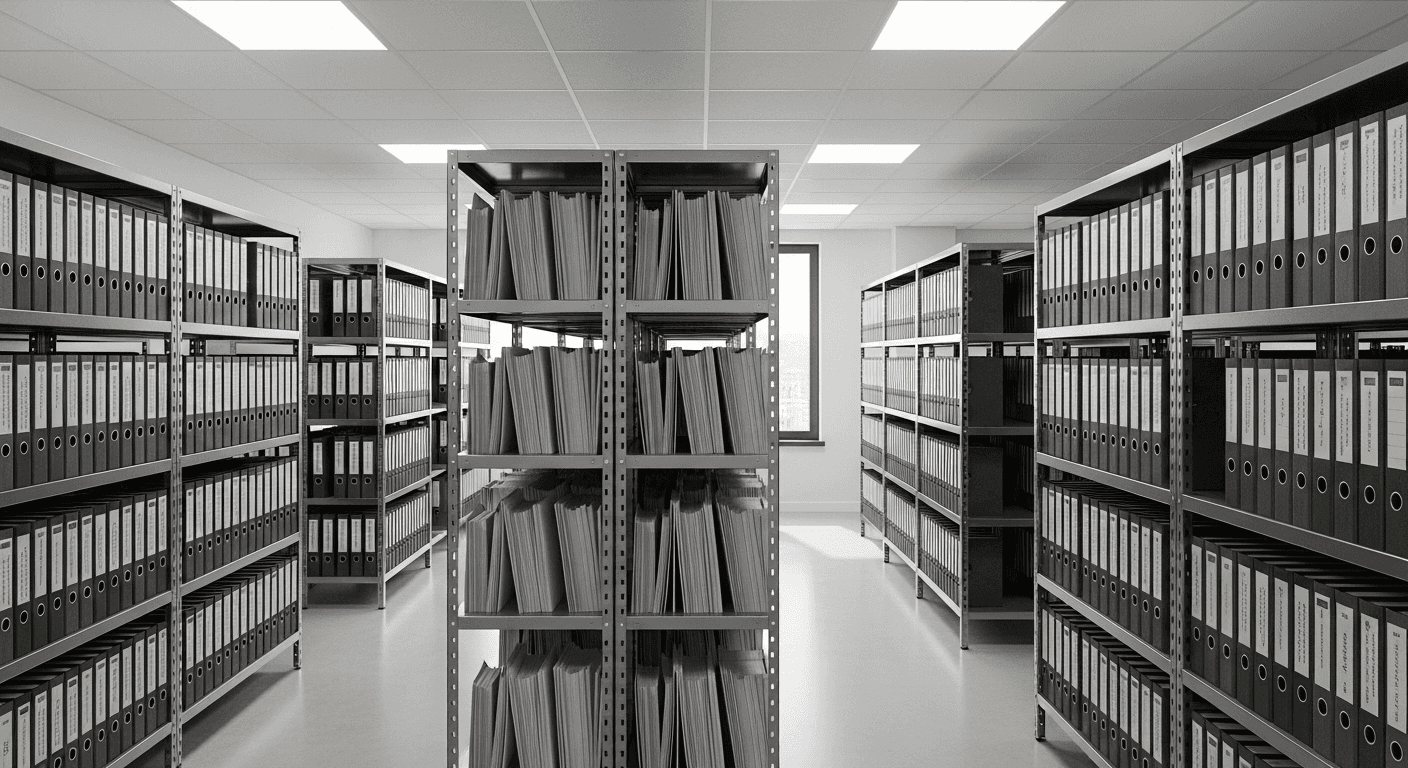
Physical storage conditions for paper documents are crucial to their durability. Archive rooms should be dry, well ventilated and protected against access by unauthorised persons. Temperature and humidity should be controlled to prevent paper and ink from deteriorating.
Organising a company archive requires systematic cataloguing of documents by chronological and subject criteria. Particular attention should be paid to storage conditions and document security
Electronic archiving offers much greater organisational possibilities but requires investment in suitable IT infrastructure. Electronic document management systems should allow quick searches by various criteria, automatic reminders of retention deadlines and reports on the state of the archive.
Backup and data redundancy are fundamental elements of electronic records security. Backups should be made regularly and kept in different locations, ideally following the 3-2-1 rule: three copies of the data, on two different media, with one copy outside the company's premises.
Inspections and consequences of non-compliance
Inspection authorities have wide powers to check how company records are kept. Inspections may be carried out by tax offices, labour inspectors, ZUS officers and other state institutions within their competence. Entrepreneurs must be ready to show documents at any time during working hours.
Preparing for an inspection requires not only complete records but also proper organisation so that the requested documents can be found quickly. Inspectors expect efficient access to documents from specific periods, which is only possible with a systematically kept archive.
During an inspection, the entrepreneur must be able to find and show the requested documents quickly. Missing documents or being unable to show them may have serious legal and financial consequences
The consequences of failing to meet archiving obligations can be very severe. Financial penalties vary depending on the type of breach and the category of documents, but may reach tens of thousands of zlotys. In addition, missing records may make it difficult or impossible to use tax reliefs, deductions or other preferences.
For employee records, failing to meet obligations may also lead to sanctions from PIP (National Labour Inspectorate). Labour inspectors pay particular attention to the completeness of employee files and compliance with retention periods.
ZUS records are inspected both by ZUS itself and by tax offices during tax inspections. Missing documents confirming payment of contributions may lead to tax-deductible costs being challenged and additional tax being assessed.
Electronic records require additional protection against data loss. An IT system failure is no excuse for missing documents during an inspection, which is why backup and data recovery systems are crucial.